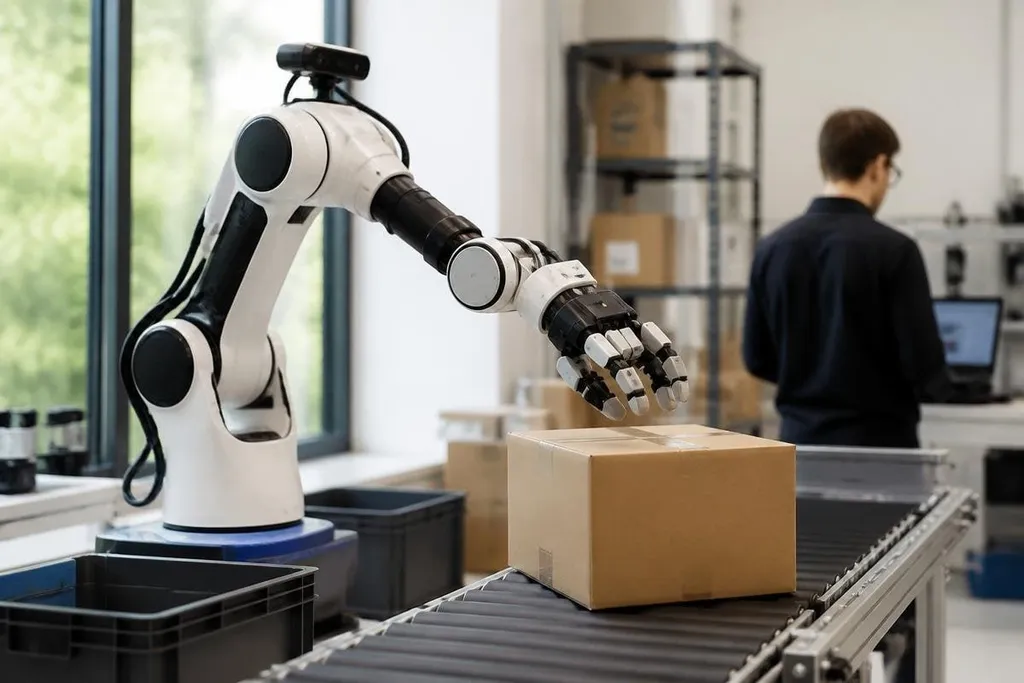
The system can now slow its hand before contact, shift its weight during a turn, and change its path when an object moves. Those small choices make motion look natural, even when the robot still needs strict limits and careful setup.
This matters to the engineer choosing an arm, mobile robot, or humanoid system because smooth movement can reduce drops, sudden stops, and wear on the hardware.
- Better sensors give the controller more useful information.
- Motion planners now link many small movements into one task.
- Natural-looking motion still depends on a controlled test area.
Sensors give the robot more time to react
Movement follows a loop. Sensors read the scene, and software estimates the robot’s position.
The controller then sends commands to the motors. The loop repeats as the robot moves, so each new reading can change the next action.
Older systems often followed a fixed path with little room for change. A newer system can use cameras, force sensors, LiDAR, or joint position data to adjust that path. A camera can spot an object, while a force sensor can tell the robot that its gripper has made contact.
That feedback changes the feel of the motion. The robot can slow down near a person, reduce force after touching a surface, or correct a foot placement when the floor is uneven. The result looks less like a sequence of commands and more like one continuous action.
The hardware still sets the limits. A motor with limited torque cannot make a heavy arm move safely through every position, no matter how good the software is.
Planning links small actions together
A task such as picking a box contains many separate steps. The robot must find the box, move its arm around nearby objects, close the gripper, lift the load, and place it in a new position. Motion planning turns those steps into a path for each joint.
The path matters as much as the destination. Reaching the right point with sudden stops may complete the task, but people will see the movement as stiff. Curved paths, slower turns, and controlled acceleration can make the same action look more natural.
Control software also manages the robot’s balance. A mobile robot may reduce speed before a turn. A legged robot may shift its body before lifting one foot. An arm may move its elbow first so the wrist follows a shorter path around an obstacle.
These choices are useful for people working near robots. Predictable movement gives a nearby worker more time to judge where the robot will go. It can also reduce the load on gears and joints, though that result depends on the task and the robot’s design.
A smoother gait can still hide a short battery or a controller that fails when the floor changes. Robot24.com’s reporting on robot movement puts the motion claim beside the machine, task, and test result needed to judge it before the limits appear.
Natural motion can hide hard limits
A smooth video proves that a robot completed one sequence under stated conditions. It doesn't prove that the system can repeat the task across new rooms, lighting conditions, floor surfaces, or object shapes.
Training data can help a robot choose motions that look less mechanical. Yet the system still needs a way to detect unsafe contact, a sensor failure, or an object outside its training examples. That safety layer may interrupt the motion and make the robot stop suddenly.
Teleoperation adds another limit. A person may guide the robot through a difficult task, with software handling balance or motor control. The movement can look natural, but the system may still depend on a human for the hardest part.
I’d judge natural movement by recovery and repeatability, not by one smooth clip.
A practical check before you buy
Use this checklist when a vendor presents a robot with human-like or smooth movement:
- Watch the full task: Look for cuts before contact, lifting, or handoff.
- Ask about control: Find out which actions run by themselves and which need teleoperation.
- Test changes: Move the object, alter its angle, or add a safe obstacle.
- Check contact: See how the robot reacts when a gripper meets resistance.
- Measure repeats: Run the same task across enough cycles to find missed grasps and stops.
- Read the limits: Check payload, reach, speed, floor needs, and safety settings.
Trust comes when useful motion continues after the scene changes. The next question for any system is practical: how many altered runs can it complete before a person has to take over?